
Why Families Are Moving Back to Inner‑City Apartments
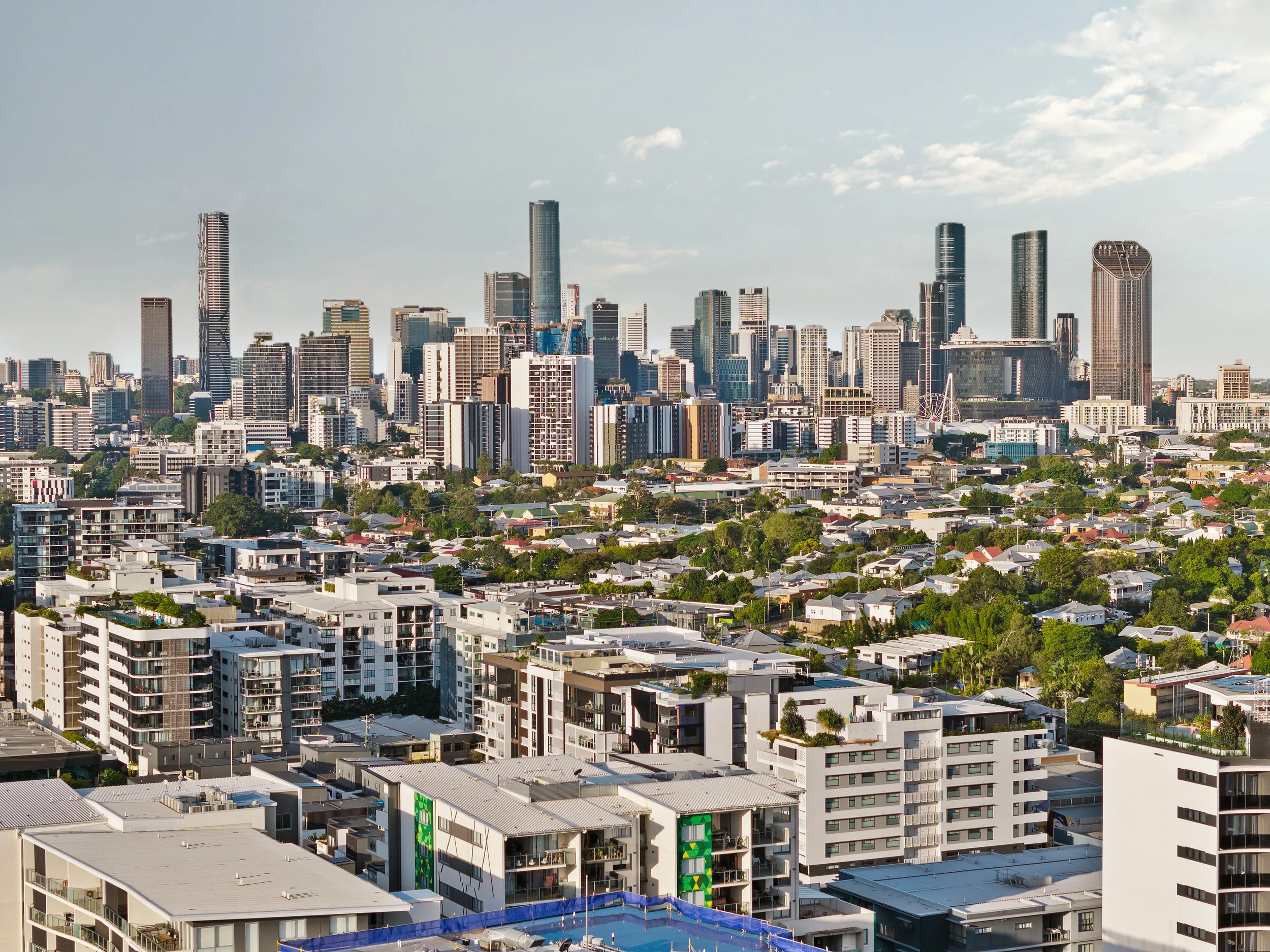
For many years, Brisbane families sought life in the suburbs, with this style of living, often delivering larger houses and backyards. As Brisbane has grown suburban living now often comes at the cost of long commutes, congested mornings, and time spent in the car rather than together at home.
Today, more families are questioning whether that trade‑off still makes sense.
As Brisbane continues to grow, expectations around how and where families live have evolved. Location, access to education and day‑to‑day efficiency are now front of mind — and for many households, inner‑city apartment living is proving to be a practical and sustainable long‑term choice.
This shift is particularly evident in established inner‑city precincts like West End, where well‑designed, larger and new apartments are supporting family life in ways that simply weren’t available a generation ago.
Inner‑City Living Works for Families — and Already Does
Families are no longer on the margins of Brisbane’s inner‑city market. According to the Australian Bureau of Statistics, Brisbane Inner City is already home to more than 70,000 families, with an average of 1.7 children per household, demonstrating that living close to the city is not only possible for families — it is well established
These households are typically families who value being close to work, schools and everyday services. Inner‑city households tend to prioritise proximity, education and amenity when making long‑term housing decisions.
In other words, families are not “trying out” the inner city — they are choosing it with intention.
Why Proximity Matters More Than Ever
One of the key reasons families are moving closer to the city is time. Brisbane commuters now spend around 45 hours a year in traffic (Source: Infrastructure Partnerships Australia) with congestion continuing to increase on major suburban routes.
For working parents, living closer to work and school can make a meaningful difference:
Mornings and afternoons are more predictable
Less time is spent driving or coordinating complex schedules
Children can access public transport more independently
Inner‑city locations provide direct access to employment hubs, transport and essential services, allowing families to spend less time travelling and more time living.
School Catchments Are Driving Real Decisions
Access to high‑quality education remains one of the strongest influences on where families choose to live. In Brisbane, few public-school catchments are as highly sought after as Brisbane State High School.
With more than 3,500 enrolled students, a strong academic reputation and an ICSEA score of 1145, Brisbane State High School is consistently ranked among Queensland’s leading public secondary schools. Enrolment is based on proof of local residence, and key application timelines — including the 19 June enrolment deadline for 2027 enrolments — mean families often need to act earlier than expected.
As a result, purchasing decisions are increasingly shaped by school planning, with families securing a qualifying address well before their children reach secondary school age.
Bankside West End is located within the Brisbane State High School catchment. For families purchasing now, this timing provides the opportunity to meet the residency requirements ahead of the 2027 enrolment deadline. Additionally, West End is also in close proximity to several prestigious private schools which are all on key bus routes including options for Girls – Somerville House, Brisbane Girls Grammar School and All Hallows’ School and for Boys – St Laurence’s College, Brisbane Boys Grammar School and St Jospeh’s Gregory Terrace.
Apartments Have Changed — So Has Demand
Modern inner‑city apartments are a world away from earlier generations. Today, apartments account for more than half of all residential sales in Brisbane’s inner city, reflecting their acceptance as genuine long‑term homes rather than transitional housing.
Families are now one of the fastest‑growing buyer groups in inner‑city apartment markets, drawn to low‑maintenance living combined with established neighbourhoods and strong infrastructure.
At the same time, supply has tightened. The proportion of newly delivered three‑bedroom apartments has declined from around 40% in 2023 to approximately 25% in 2025 (Source: Cordell Connect Construction Intelligence), as more developments favour smaller layouts. This has made larger, family‑suitable apartments increasingly difficult to find.
Why Families Continue to Choose West End
West End offers a balance that is increasingly hard to replicate. Close to South Brisbane, the CBD and major employment centres, it remains distinctly residential in character, with quieter streets, strong public transport links and access to a wide range of established schools.
For families, this means:
Schools and public transport within walking or cycling distance
Less reliance on cars as children grow older
An inner‑city lifestyle without the intensity of the CBD
Riverside living, while remaining moments from everything
It is a neighbourhood where families can put down roots, not just pass through.
Bankside West End is Designed for the Way Families Live Today
Bankside West End offers recently completed three- and four-bedroom apartments designed for families, providing generous internal layouts within an established inner‑city setting. The residences are suited to owner‑occupiers seeking space and long‑term livability without leaving Brisbane’s inner city.
The development is located within the Brisbane State High School catchment, with access to surrounding private schools and well‑connected public transport.
With limited availability of larger apartments in established inner‑city locations, and demand supported by schooling and proximity considerations, opportunities of this nature remain relatively scarce.
